System Design of WhatsApp Mobile Application 📱 Scalable Architecture, Diagram & Key Components
April 22, 2026
WhatsApp is one of the most widely used messaging platforms, handling billions of messages daily. Designing such a system requires careful planning around scalability, reliability, low latency, and real-time communication.
In this blog, we’ll break down:
- High-level architecture
- Core components
- Message flow
- Database design
- Scaling strategies
- System design diagram
🎯 Requirements
✅ Functional Requirements:
- One-to-one messaging
- Group messaging
- Media sharing (images, videos, documents)
- Online/offline status
- Message delivery status (sent, delivered, read)
⚡ Non-Functional Requirements:
- High availability
- Low latency (real-time delivery)
- Scalability (billions of users)
- Security (end-to-end encryption)
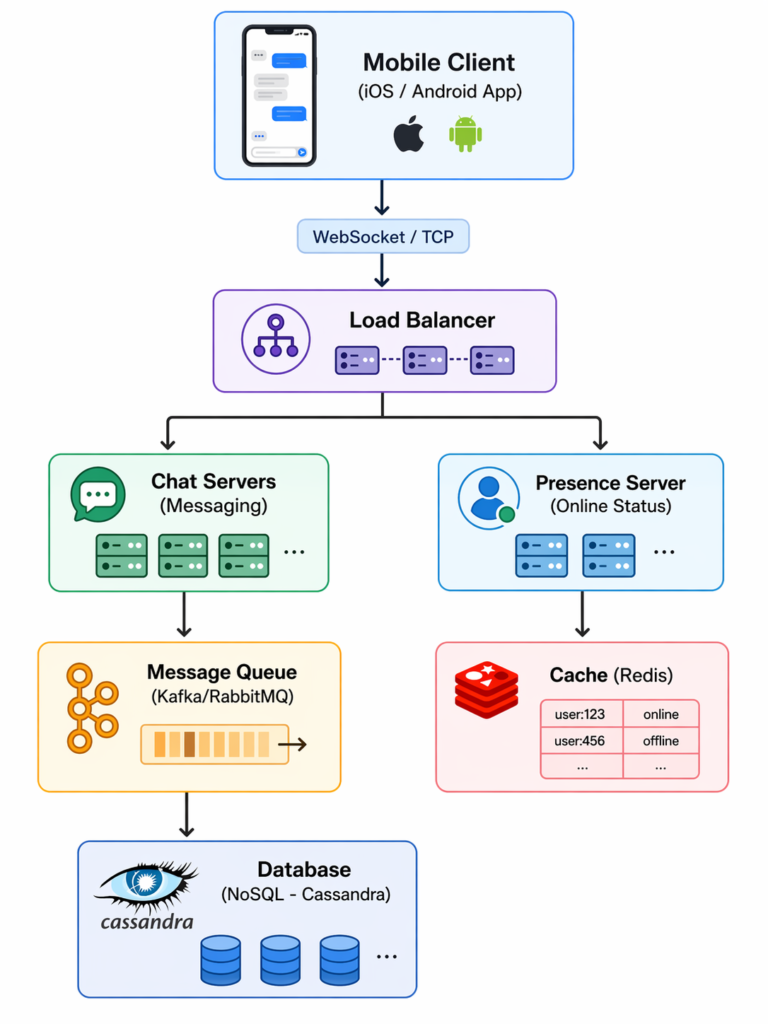
🏗️ High-Level Architecture
🧩 Core Components Explained
1. 📱 Mobile Client
- Maintains persistent connection using WebSockets
- Sends/receives messages instantly
- Handles retries for failed messages
2. ⚖️ Load Balancer
- Distributes traffic across multiple servers
- Ensures high availability
- Prevents server overload
3. 💬 Chat Servers
- Core of messaging system
- Handles:
- Message routing
- Delivery acknowledgments
- Temporary message storage
4. 🟢 Presence Server
- Tracks user status:
- Online / Offline
- Last seen
- Uses in-memory storage (Redis) for fast updates
5. 📬 Message Queue (Kafka / RabbitMQ)
- Ensures asynchronous processing
- Handles:
- Message delivery retries
- Buffering during high traffic
6. 🗄️ Database (Cassandra / DynamoDB)
- Stores:
- Messages
- User data
- Media references
- NoSQL is preferred for:
- High write throughput
- Horizontal scaling
7. ⚡ Cache (Redis)
- Stores:
- Recent chats
- User sessions
- Improves response time
🔄 Message Flow (Step-by-Step)
- User A sends a message
- Message goes via WebSocket to Chat Server
- Chat Server:
- Validates user
- Stores message in DB
- Pushes to message queue
- Message delivered to User B if online
- If offline:
- Stored in queue
- Delivered when user reconnects
- Delivery acknowledgment sent back
🔐 Security (End-to-End Encryption)
- Messages are encrypted on sender device
- Only receiver can decrypt
- Server cannot read messages
📦 Database Design (Simplified)
Messages Table:
Message {
  message_id
  sender_id
  receiver_id
  timestamp
  content
  status
}
Users Table:
User {
  user_id
  phone_number
  last_seen
  status
}
📈 Scalability Techniques
🔹 Horizontal Scaling
- Add more chat servers dynamically
🔹 Partitioning (Sharding)
- Split users across servers using:
- Hash(user_id)
🔹 Replication
- Duplicate data across multiple nodes
🔹 CDN for Media
- Store images/videos using CDN for faster delivery
⚡ Real-Time Communication Strategy
- Use WebSockets instead of HTTP
- Maintain persistent connection
- Reduces latency significantly
🧠 Interview Tips (Very Important)
If asked in system design interview:
👉 Always mention:
- WebSockets for real-time
- Message queue for reliability
- NoSQL DB for scalability
- Load balancing
- Offline message handling
👉 Bonus points:
- Mention encryption
- Mention push notifications fallback
🧩 Advanced Enhancements
- Typing indicators
- Message reactions
- Voice/video calling (WebRTC)
- AI-based spam detection
🏁 Conclusion
Designing a WhatsApp-like system involves:
- Real-time communication
- Massive scalability
- Fault tolerance
- Strong data consistency
The key is balancing performance, reliability, and user experience.